

By Victoria A. Platt, Director of Research
Artificial intelligence (“AI”) is transforming valuation, appraisal, forensic accounting, and financial advisory services by enhancing research, data analysis, and reporting efficiency. Although AI tools offer significant benefits, professionals remain responsible for ensuring the accuracy, reliability, transparency, and defensibility of their work. AI is a tool that enhances, rather than replaces, professional expertise, and ongoing education and adherence to professional standards are essential for maintaining credibility in an increasingly AI-driven environment.
Introduction
AI use in the financial services sector is a frequent topic among valuation professionals, litigation experts, forensic accountants, and transaction advisors. The integration of AI into our global information ecosystem has changed the metaphorical information highway to a multilane hyper-connected autobahn. AI tools now affect the manner and speed in which we conduct research, analyze data, query databases, verify legal citations, and review academic sources.
But maintaining professional competency, consistency, and transparency when utilizing AI tools goes beyond a basic understanding of what AI can do. AI tools are evolving rapidly, and professionals have to be aware of the challenges of using AI. By following guidance and standards from professional associations, along with sound information-literacy practices, professionals can use AI in a reliable, credible, and efficient manner while remaining responsible for protecting confidential information and exercising professional judgment.
A Brief History of AI
Although not the earliest, some of the most recognizable AI references are from science fiction movies. HAL 9000 was a sentient, superintelligent AI that controlled a spacecraft in the 1968 movie, 2001: A Space Odyssey. In the 1983 movie WarGames, Dr. Stephen Falken created WOPR (War Operation Plan Response), a supercomputer programmed to simulate combat scenarios. General public use would take about 10 more years.
In the early 1990s, the information highway was used to retrieve information by searching indexes and web pages over dial-up systems, fiber-optic cables, and Internet browsers. A major shift in how people interacted with AI occurred in 2011 when Apple’s voice-activated AI assistant (Siri) set alarms and sent messages on command. The modern AI era later shifted from rigid, rule-based queries to autonomous systems that learn from vast datasets using advanced machine learning when OpenAI released ChatGPT in 2022.
Types of AI
Arguments have been made that there are between four and seven different types of AI. In 2025, Poojan Vig defined seven types of AI and separated them into two categories, as presented in Table 1: one by capabilities and the other by functionalities.
Table 1: Types of AI
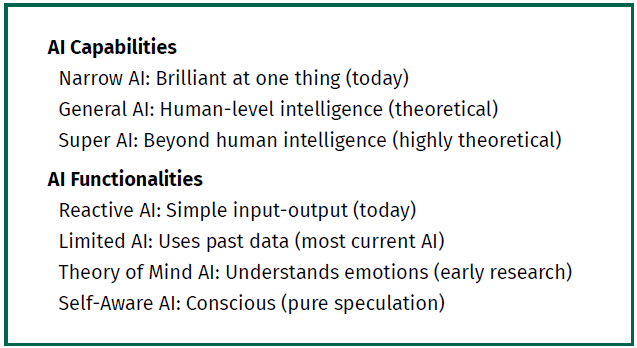
Source: Poojan Vig, “Understanding AI: The 7 Types of Artificial Intelligence,” Medium (June 3, 2025).
Of the seven types of AI, the three types used publicly today are Narrow, Reactive, and Limited. Examples of frequently used Narrow AI include voice assistants, such as Siri and Alexa. Reactive AI examples are simple systems, such as spam filters and rules-based chatbots. Large language models (“LLMs”) (ChatGPT) and recommendation systems (Netflix) are examples of Limited AI.
To understand the various types of AI, familiarity with a select number of AI terms is helpful.
Table 2: Common AI Terms
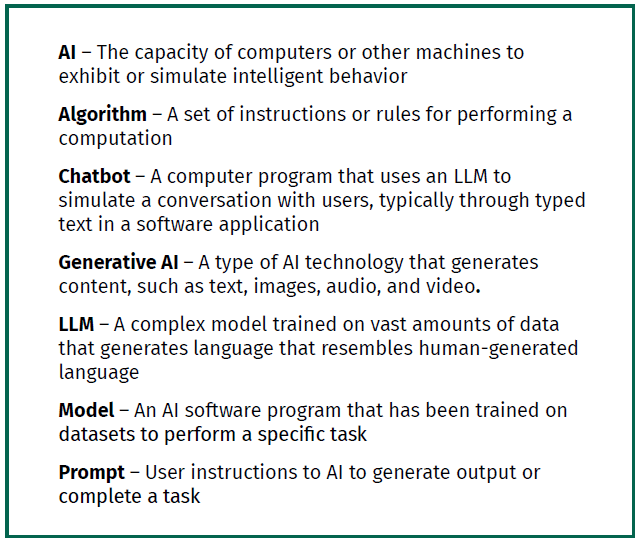
Source: Artificial Intelligence Teaching Guide, Stanford University.
How AI Can Help or Hinder an Engagement
Professionals in the financial services industry use a wide range of tools, including spreadsheets, financial benchmarks, subscription-based databases, market data platforms, machine learning systems, and AI. These tools can assist professionals with organizing available information, identifying relevant market data, analyzing trends, and streamlining certain research and reporting tasks.
The use of technology does not diminish the practitioner’s responsibilities because the practitioner remains in control of the assignment. The practitioner determines the scope of work, evaluates the appropriateness of the technology being used, assesses the reliability of the inputs and outputs, and applies professional judgment in reaching assignment results.
A basic understanding of AI technology assists the practitioner in assessing the accuracy and reliability of AI outputs. For example, a generative AI chatbot works by “reading” a large amount of existing text and “learning” how words tend to appear in context with other words. The chatbot then uses what it has learned to predict, through probabilities and randomness, the most likely word that might appear next in response to a user request. Understanding how AI arrives at the output helps decide whether using the AI output is dependable.
With the power of AI being leveraged in many applications, assessing the AI tool being used is essential. The ROBOT Test, created at McGill University in 2020, was developed to help students, researchers, and professionals assess AI rather than accept outputs at face value. AI tools can be evaluated by assessing these five concepts:
- Reliability – Is consistency and repeatability of the results obtained?
- Objective – Is the result based on real facts?
- Bias – Is there any bias?
- Ownership – Is the origin of the tool known?
- Transparency – Can the output be verified?
Awareness of the limitations, or challenges, in AI tools is necessary to make informed decisions about using AI output. Several risks in using AI include algorithmic bias, data privacy, the need for critical thinking, natural language searching versus semantic search, and rapid transformation of AI tools. Each of the risks raises concerns regarding the scope of work, transparency, confidentiality, record keeping, and credibility of search results. A thorough understanding of how these risks influence the AI output directly influences the accuracy of the output.
One AI risk receiving attention is algorithmic, or machine learning, bias. Algorithmic bias in information retrieval occurs when skewed or limited training input data, subjective programming decisions, or result interpretations systematically favor certain viewpoints, demographics, or data sources. Algorithmic bias can lead to the misrepresentation of findings and distorted outcomes because of underrepresented data or the replication of hidden patterns of human discrimination.
Algorithmic bias has been identified in a variety of AI tools, ranging from facial recognition to resume-screening, mortgage underwriting, and traditional information retrieval systems. Addressing AI bias is a difficult technical and ethical challenge that courts in the United States are starting to tackle. U.S. courts recently reached the conclusion that companies using AI, and the vendors supplying it, can be held liable for discriminatory conduct.
The accuracy and integrity of references used in data analysis, research literature, online sources, court filings, and information retrieval are under threat from “deepfakes” and hallucinations. Deepfakes are deliberate, or false, manipulations of media, by humans, created to deceive people. Hallucinations are AI mistakes, or fabrications, created when the model produces output that contains false or misleading information presented as fact. Consequently, hallucinations occur because AI tries to predict what “sounds right” rather than what is objectively true. Hallucinations can read like facts, be formatted like real sources, and sound completely plausible. Understanding the differences between deepfakes and hallucinations is important because the former involves disinformation (malicious intent) and the latter misinformation.
Further, confidentiality and data protection remain fundamental professional obligations. Before incorporating AI-enabled tools into an engagement, professionals should evaluate the applicable privacy, confidentiality, and security requirements associated with those tools to protect client information.
AI Information Literacy
Despite numerous issues around the use of AI for professional engagements, it is possible to ensure quality, transparency, and defensibility in the work product. In 1989, the American Library Association defined an information-literate person as someone who can recognize when information is needed, locate the information, evaluate the information, and use the information effectively. Today, information literacy goes beyond traditional research skills and includes a current understanding of what AI can and cannot do.
Following a sound information-literacy framework is necessary, but so, too, is ensuring that the output can be replicated by distinguishing between factual findings and AI-generated interpretations. Verifying the factual accuracy of AI-generated content is the responsibility of the professional using it in their work product.
At the end of 2025, representatives from four major valuation professional organizations (American Institute of Certified Professional Accountants [“AICPA”], National Association of Certified Valuators and Analysts, American Society of Appraisers [“ASA”], and The Appraisal Foundation) participated in an online seminar and offered practical advice on using AI in the valuation profession.
The recommendations not only included information-literacy skills but highlighted the need for continuous education to ensure consistent and responsible use. As moderator Rod Burkert of Burkert Valuation Advisors concluded, the profession is heading into a period where AI literacy will become an essential part of valuation literacy. “AI isn’t going away,” he said. “Training is what will keep us credible.”1
AI and Professional Guidance
A federal framework for regulating AI is being considered by Congress under the title the Great American Artificial Intelligence Act. But without federal statutes or regulation, professionals in the financial services industry look to published guidelines or standards from associations and professional bodies.
Professional associations issue guidelines and standards to ensure best practices, and ethical standards are established for each respective industry. Valuation professionals, litigation experts, forensic accountants, and transaction advisors adhere to that guidance to maintain their credentials, as well as their integrity, reliability, and professionalism. However, professional associations vary in how they provide guidance on the use of AI and AI tools.
Within the business valuation community, there is some consensus among professional associations that AI is a tool and does not change the existing standards requiring professional competence and due care. Some professional associations (AICPA, ASA, and Charter Business Valuators Institute [“CBVI”]) provide insight on using existing standards in relation to AI but have not issued new standards specific to AI use.
Early in 2024, the CBVI published Primer on Artificial Intelligence: Essential Considerations for CBVs on the Responsible Use of AI. The ASA recommends the use of guidance statements (January 2026), without requiring their use by appraisers. In April 2026, AICPA issued “AICPA Small Firm Generative Artificial Intelligence Policy Template.”
The International Valuation Standards Council (“IVSC”), an independent global standard setter for the valuation profession, provides valuation professionals with several resources on AI use. In 2025, the purpose of the Advisory Opinion is to clarify how existing IVSC published the perspectives paper, “Navigating the Rise of Artificial Intelligence in Valuation-Opportunities, Risks, and Standards.” In addition, on May 8, 2026, IVSC released the AI in Valuation Sentiment Tracker. The tracker explores how AI is evolving within the valuation process, the pace of that evolution, and how stakeholder sentiment is changing as new technologies become more embedded in valuation workflow. The IVSC says the data collected would help to inform further guidance and standards regarding AI.
Along those lines, the IVSC is circulating an exposure draft with proposed changes to the International Valuation Standards that would go into effect in January 2028. Changes pertaining to AI seek transparency in the scope of work when valuation professionals have “significant use of artificial intelligence and other technology-based tools and resources.”2
On April 23, 2026, the Appraisal Standards Board of The Appraisal Foundation adopted an updated Advisory Opinion 41 (AO-41), Use of Technology in an Appraisal or Appraisal Review Assignment that addresses AI use. The purpose of the Advisory Opinion is to clarify how existing Uniform Standards of Professional Appraisal Practice requirements apply when valuation professionals use such tools in the development and communication of assignment results, rather than establish new standards. The guidance addresses issues such as reliance on AI- generated information, an appraiser’s responsibilities, work file requirements, and reporting considerations.
As AI becomes increasingly integrated into valuation, appraisal, forensic, and advisory practices, financial professionals must remain vigilant in understanding and applying existing professional standards. Although most professional organizations have not developed new AI-specific standards, there is agreement that AI is a tool that does not diminish a professional’s obligation to due care, competence, professional judgment, and accountability. As regulatory and professional guidance continues to evolve to reflect that, financial professionals must monitor developments and ensure that AI enhances, rather than replaces, the expertise and judgment upon which clients and courts rely.
AI in Practice
The use of AI-generated hallucinated citations and deepfake evidence in the legal profession has received considerable attention as attorneys and expert witnesses are increasingly being held accountable for using AI in their work product. On June 9, 2026, a federal judge in Mississippi punished four attorneys for filing court documents that cited fake cases. The law firm for one of the attorneys had a policy requiring all legal research to be verified before filing with the court. The attorney was punished by the court for violating the firm’s policy and Rule 11 of the Federal Rules of Civil Procedure.
On May 18, 2026, Magistrate Judge Thomas O. Farrish of the U.S. District Court for the District of Connecticut ordered the plaintiff in Conservation Law Foundation v. Shell Oil Co. to produce the generative AI prompts that its expert witness, Dr. Naomi Oreskes, used in preparing her expert report. Magistrate Judge Farrish found that “[a]n expert witness’s methodology is fair ground for discovery” and that “the process by which Dr. Oreskes culled down the defendants’ document production into a subset to be worked with is an aspect of that methodology.”3 This appears to be the first federal court decision requiring an expert witness to disclose AI prompts as part of discoverable methodology for the expert’s opinions.
Three years ago, Josh Autenrieth, of Knighthawk Engineering, was hired by 3M for an independent expert assessment of 3M’s responsibility for a 2020 explosion at Watson Grinding in Houston, Texas. During discovery, the plaintiff’s attorney uncovered a five-page document called “citation overlay.” At Autenrieth’s deposition, all AI prompts and conversations used to write the report were then demanded.
Autenrieth ultimately conceded at trial that “90 to 85 percent” of the report was written by AI.4 A $90,000 engagement billed at $475 an hour unraveled in three hours of discovery pressure all because an expert prompted ChatGPT to ghostwrite and mock cross-examine his report without proper oversight.
Courts expect transparency, verification, and professional judgment. Failure in these areas can result in sanctions and damage to professional credibility.
Summary
As the use of AI expands, professionals should be mindful that prompts, inputs, outputs, and related workflow might become subject to scrutiny in litigation or regulatory proceedings. Accordingly, professionals should exercise care in deciding what information is entered into AI-enabled systems and ensure compliance with applicable confidentiality obligations.
AI is reshaping how valuation professionals perform, deliver, and scrutinize client engagements. Understanding how AI directly influences retrieved results, data output, and analyzed content goes beyond the level of information literacy needed to locate, evaluate, and effectively use information.
But AI use also requires an additional set of skills. Critical thinking, recognizing bias, understanding the content creator, and being familiar with ethical standards and norms are essential to remain at the forefront of the financial services industry.

About the Author

Victoria A. Platt is director of research at Willamette Management Associates, based in our Chicago office. She can be reached at (773) 399-4314 or at vaplatt@willamette.com.
References:
- “Education-Not New Rules-Will Shape the Future of AI in Valuation,” Business Valuation Update (January 2026).
- International Valuation Standards Council, “International Valuation Standards: Summary and Consultation Questions,” Consultation Period 31 January 2026 to 30 April 2026.
- Conservation Law Foundation v. Shell Oil Co., No. 3:21-cv-00933, (D. Conn. April 15, 2025).
- Joe Patrice, “Expert Asked ChatGPT ‘Show How 3M is 0% at Fault’ Making for Entertaining Deposition,” Above the Law (August 18, 2026).